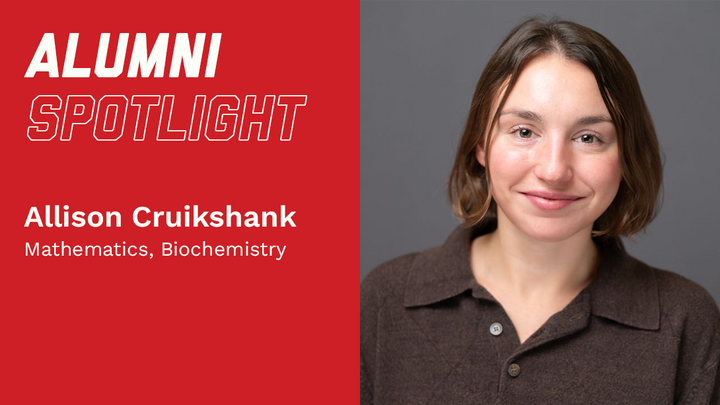
Major(s): Mathematics, Biochemistry
Graduation year: 2021
Who is your employer, and where are they located?
I will begin a role as a pharmacometrician at AbbVie in North Chicago, IL on July 7, 2026.
What is your job title and what kind of work does it involve?
The job title is Pharmacometrician. In this role, I use mathematical models to study how drugs move through and affect the body. By combining biology, math, and computation, I help predict how different doses or treatment strategies will work in patients. This modeling guides how clinical trials are designed and helps researchers make better decisions about drug safety and effectiveness.
What sparked your interest in your majors?
I’ve always enjoyed math and biology, but they felt like separate subjects to me at first. When I learned that mathematics could actually be used to model and understand processes in the human body, it completely changed how I saw both fields. That moment is what sparked my interest in mathematical biology.
What do you see as the value of your majors or CAS degree?
Studying math and biochemistry showed me the value of approaching problems from multiple perspectives. Math trained me to think logically and quantitatively, and many of my courses emphasized real-world applications, which helped me see how these concepts are actually used. Biochemistry gave me insight into real biological systems. Together, they allowed me to understand how mathematical techniques can be applied to complex processes in the body, which ultimately led me to pursue a PhD in this area.
Were there any other people, activities, or events from your time at UNL that helped you get to where you are now?
Being part of the Association for Women in Mathematics (AWM) chapter was a big part of my growth. Through its events and conversations with other members, I was exposed to the many different paths you can take with a math degree, including graduate school, which I hadn’t seriously considered before.
In addition, my thesis advisor, Dr. Huijing Du, was incredibly supportive and introduced me to my first project in mathematical biology. That experience played a key role in shaping my interests and ultimately led me to pursue this field further.
Tell us about the path you took to get to where you are today in your career and how you applied your education to get here.
After graduating, I pursued a PhD (conferred May 2026) in mathematics at Duke University, where I worked with Dr. Michael Reed on modeling sex differences in metabolism. My work focused on using mathematical models to better understand how biological processes in the body differ between the sexes and how that can impact health and disease.
My math major gave me the strong quantitative foundation needed for graduate coursework and research, while my biochemistry major provided the biological background to understand the systems I was modeling. Combining these two areas allowed me to apply mathematics to real physiological problems, which ultimately led me to my current role in drug development.
What are your future professional goals?
My goal is to continue improving human health by developing mathematical models of biological systems to support drug development. I’m especially interested in advancing work in women’s health, building on my graduate research on how sex hormones influence biological processes. I hope to continue applying these approaches to better understand differences in disease and treatment outcomes.