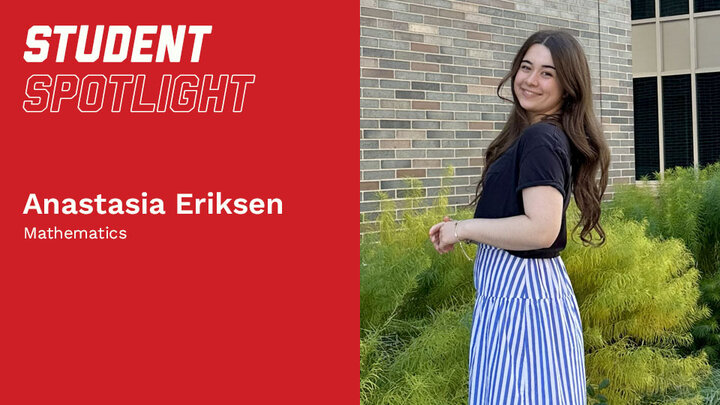
Major: Mathematics
Minor: Education Studies
Hometown: Lincoln, Nebraska
Anastasia, a junior in the College of Arts and Sciences, is majoring in mathematics with a minor in education studies. Outside the classroom, she enjoys learning new languages, reading, and spending time with her friends and family. She is preparing for her second year of research and is excited to spend a year studying abroad in Northern Italy.
While Anastasia always knew she wanted to pursue the physical or mathematical sciences as an undergraduate, her experiences after arriving on campus helped to clarify her academic focus.
"Meeting the people and seeing the strong support system, from study groups to internships, in UNL’s math department made switching to mathematics halfway through my first semester an easy choice," Anastasia said. "I added a minor in education studies more recently because I'm passionate about learning how to communicate technical ideas better."
One of Anastasia's most impactful courses so far has been MATH 309: Introduction to Mathematical Proofs. She noticed she shifted from simply solving equations to feeling like a mathematician when she took it her first year.
"The whole course is built around logic, reasoning, and fundamental proof techniques, and it honestly felt like learning a brand-new language," Anastasia said. "It gave me the confidence I needed to jump into 400-level coursework, and getting to assist with the class last semester brought the experience full circle."
Anastasia began university determined to pursue undergraduate research early and actively sought opportunities from her first year on. This proactive approach has proven beneficial.
"While taking a physics research seminar, Dr. Irina Filina spoke to our class about her Geophysics Research Group," Anastasia said. "She was incredibly passionate and approachable, so I reached out to her after her talk. We connected, put together a proposal for a mathematical modeling project, and secured a UCARE grant that ran from Summer 2025 through Spring 2026."
She shares how she utilized her mathematical skills during her research project.
"I built mathematical models to simulate Earth’s magnetic field in the North Atlantic Ocean," Anastasia said. "As new ocean floor forms at mid-ocean ridges, the rock records the Earth’s magnetic field at the moment it was created. Using geometry, MATLAB, and geophysical equations, I generated synthetic magnetic patterns of the seafloor to compare against real-world observations. This helps us better understand plate tectonics and how seafloor spreading has evolved over millions of years."
Anastasia is grateful for the real-world lessons that the opportunity offered.
“Learning how to handle the long game of research was a huge learning adjustment," she said. "Classroom assignments and problem sets give you the impression that math problem-solving is quick and linear. Research taught me the exact opposite. Real math is messy; it involves a ton of trial and error, and new breakthroughs take months of work. Realizing that failure and troubleshooting are just normal parts of the process- and that it takes a team to navigate them- has been the most valuable takeaway from experiential learning."
She credits this experience with helping her to develop invaluable technical and professional skills.
"On the technical side, I’ve gained hands-on experience programming in MATLAB to model complex geological data," Anastasia said. "On the professional side, co-authoring scientific goals clearly, while designing posters and presenting my findings, forced me to translate high-level math into accessible and understandable stories."
Anastasia is grateful to her faculty sponsor, Dr. Irina Filina, whose mentorship has deeply impacted her academic development. Because their first UCARE research project turned out so well, they are starting a second UCARE grant this academic year.
"She took a chance on me when I was a freshman with no prior research experience, and she welcomed me into her lab with incredible patience and guidance," she said. "Her continuous support, encouragement, and investment in my personal and professional development have completely shaped my undergraduate journey."
Although Anastasia is still considering her long-term career options, she knows she wants to attend graduate school once she completes her undergraduate coursework. Because of her experiential learning, she feels better prepared for this next step.
"This project has given me a realistic view of high-level academic work," she said. "Having hands-on experience co-writing grants, navigating messy real-world data, and building models from scratch will make a massive difference in preparing me for the rigor of a graduate degree.